
Walk Like an Egyptian: Exploring Ancient Egypt Through Literature
Introduction | Background Knowledge | Activities | Extensions | Standards
Introduction
Water sustains life, and early humans flocked to the Nile River for water and food. As more people moved along the Nile, they formed tribes, living together for the betterment of all. These tribes developed skills and culture that would be the basis of one of the world’s greatest civilizations. For example, the tribes had a grasp of how to make plants and animals serve them through agriculture and animal husbandry. They traded with other communities in Africa and began using written pictures to communicate. Ancient Egypt rose to greatness about 3100 BCE when Menes, the first king of the first dynasty, unified Upper and Lower Egypt.
Background Knowledge
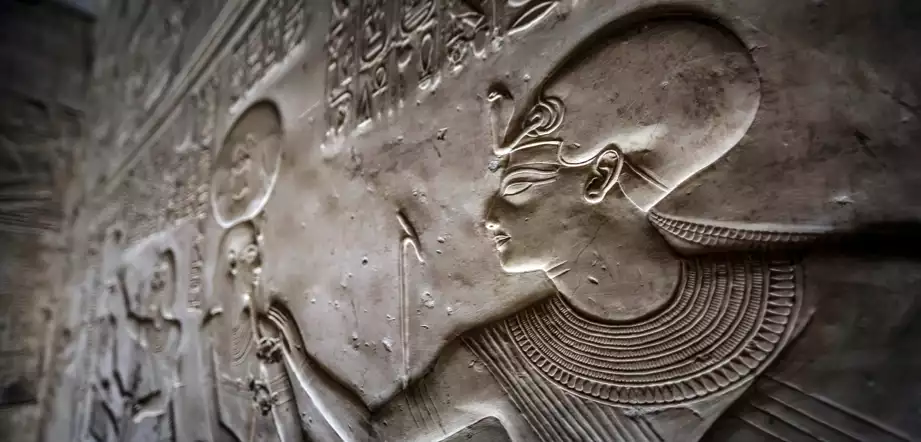
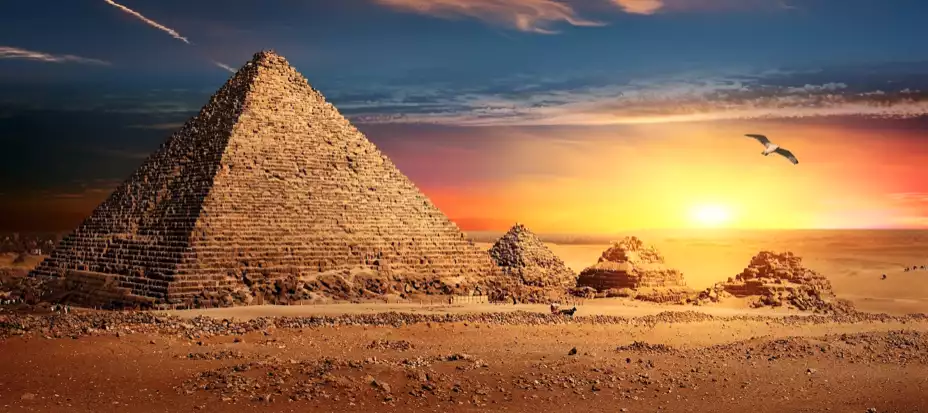
Click the image above to view a video that shows more about Ancient Egypt.
The first 500 years (c. 3150- 2686 BCE) of the Ancient Egyptian civilization are known as the Early Dynastic Period. One major outcome from this period was the establishment of the capital at Memphis. The consolidation of Upper and Lower Egypt was slow, but the cultural advances were fast. Early hieroglyphics from this period have been found, but the language symbols represented remain unknown. Wealthy Egyptians began to request more elaborate burials, setting the stage for the opulence to come. Egyptians began to use copper during this period. They began to build with sun-dried bricks. They began to use decorative architecture such as arches and recessed walls. Towns and villages along the Nile solidified trading routes and organized the labor force to increase output. Leaders looked to the gods to legitimize their rule in the vein of divine kingship.
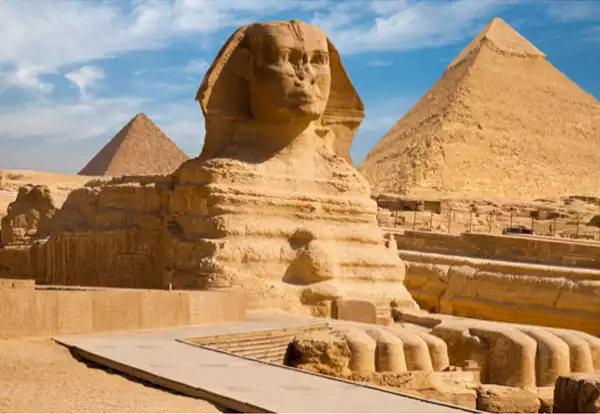
The Old Kingdom (2686 - 2181 BCE) is known as the “Age of Pyramids.” Egypt flourished during this period. The government was unified and organized. The vizier, the highest state official to serve under the king, coordinated the government. Under the viziers’ leadership, the government collected taxes, established a justice system, and organized construction projects and the workforce to complete the projects. A class system also began to take shape. Kings such as Khufu had the Great Pyramids at Giza built to house them in the afterlife. The Great Sphinx was erected to guard the pyramids.
After the prosperity of the Old Kingdom, Ancient Egypt had a “dark period” known as the First Intermediate Period (2181 - 2055 BCE). The government could not sustain the economy. Food shortages combined with political disarray caused famines throughout the country. With the fall of the central government, local leaders took control of their regions. With no oversight from a centralized government, the local provinces were able to increase their wealth. This prosperity trickled down to all citizens, evidenced by larger and more extravagant burials for all classes. Rival leaders took control of Upper and Lower Egypt, once again separating them. The country reunited in about 2055 BCE.
The reunification ushered in the Middle Kingdom (3124 - 1690 BCE). The Middle Kingdom era restored structure, peace, and prosperity to Ancient Egypt. This period saw a return of artistic, literary, and architectural projects in Egypt. Unlike the Old Kingdom, which focused on the many gods of Egyptian mythology, the Middle Kingdom emphasized personal reverence. Kings focused on increasing agricultural output and used the Nile River's power to irrigate crops across the region. Later in the period, the kings overextended their reach and diverted an abundance of resources to building and mining projects. There were years of extreme Nile flooding that devastated the region's agricultural fields. Settlers in the Nile Delta began to control the region and eventually took control of Egypt.
The Hyksos, or “foreign rulers,” seized control of Egypt as the rulers of the Middle Kingdom weakened. Their reign is known as the Second Intermediate Period (1674-1549 BCE). The Hyksos retained many customs and government models upon coming to power. For example, they introduced the composite bow and the horse-drawn chariot to the Egyptian people. Many Egyptian rulers tried to overthrow the Hyksos. One conflict lasted 30 years but was unsuccessful. Finally, Ahmose I defeated the Hyksos, sent them from Egypt, and established a new dynasty.
After the Hyksos were driven from power and driven from Egypt, the era of the New Kingdom (1549 - 1069 BCE) began. During this time, the kings of Egypt began to be known as pharaohs. The New Kingdom was the most powerful period of Ancient Egypt. Hatshepsut, a powerful female pharaoh, rebuilt many temples destroyed by the Hyksos. She also re-established trade partnerships. The pharaoh who followed her expanded the empire and began to import bronze and wood. Temples and monuments were a focus during the New Kingdom, with many temples built to glorify the god Amun. Many pharaohs built monuments to highlight their accomplishments, real or not.
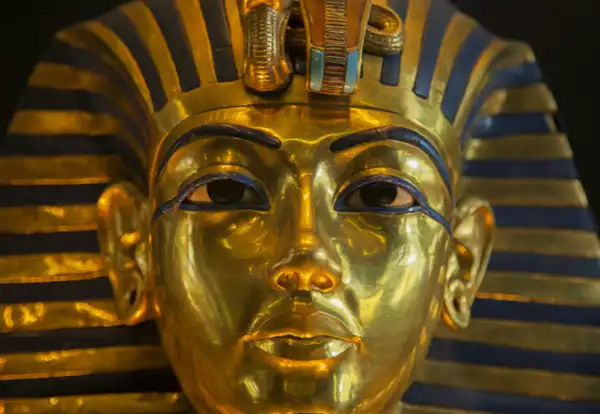
Around 1350 BCE, Amenhotep IV ascended to power, and his actions threatened to undo all the progress made in this era. He changed his name to Akhenaten and devoted his life to elevating the obscure sun god Aten to the supreme deity of Egypt. After his death, the subsequent pharaohs restored the traditional religion. One of these pharaohs was the boy king, Tutankhamun, known more for his death mask than his time as pharaoh. Around 1279 BCE, Ramses II, known as Ramses the Great, came to power. He was known as a strong leader who built many temples, statues, and obelisks around the country. He was also known to be the father of many children, ensuring a line of succession. He was a brilliant military mind and led his army to the first recorded peace treaty in 1258 BCE after a conflict with the Hittites ended in a stalemate. As Egypt and its wealth grew, so did the challenges for power from outside the country. Pressure from abroad also created internal conflicts in the country, such as corruption, civil unrest, and tomb-robbing. The pharaohs lost power to the priests from the Temple of Amun, who amassed land and wealth but fractured Egypt.
When Libyan princes came and took control of Egypt, the country entered another period of uncertainty known as the Third Intermediate Period (1069 - 652 BCE). Shoshenq I, the first Libyan to rule Egypt, vaulted his family members into favorable positions as priests. This dynasty ruled Egypt for 200 years until the Kushites invaded from the south and took over. Kushite pharaohs restored and rebuilt temples and monuments in the Nile Valley. They are also responsible for constructing the first new pyramids since the Middle Kingdom. The Assyrians had taken control of many of Egypt’s allies, and between 671 and 667 BCE, they launched an assault on Egypt and came to power, ending the Third Intermediate Period.
The Late Period (643 - 332 BCE) began when the Assyrians were driven out of Egypt and the twenty-sixth dynasty, consisting of Saite kings, came to power. Aided by Greek mercenaries who formed the first Egyptian navy, Egyptian culture began to see Greek influence. The Saite rule was brief, and the powerful Persian dynasty conquered Egypt in 525 BCE. For almost 200 years, Egypt vacillated between Persian and independent rule until 332 BCE, when Egypt was given to Alexander the Great without conflict.
Alexander the Great conquered Egypt. Rather than being seen as an invader, the Egyptians regarded the Greek leader as a rescuer. Alexander the Great brought in the Ptolemaic Era (332-30 BCE). This was a time of Hellenistic rule. The capital was moved to Alexandria, which became a center of learning and culture. Under his control, the Library at Alexandria, one of the great wonders of the ancient world, was created. Alexander the Great and the Ptolemaic leaders who followed him did not try to change Egyptian culture. Many of their building projects were in the Egyptian style. Despite the attempts to placate the Egyptians, the Ptolemies faced challenges, including rebellions, family rivalries, and insurrections. The Romans took notice and intervened.
When the Roman Empire defeated Cleopatra in 30 BCE, the Ancient Egyptian era ended. The civilization lasted for over three millennia. It survived for so long because the people learned to harness the Nile River to thrive in the region. They developed an irrigation system and complex agricultural systems. The leadership system centered on the pharaoh provided unity and maintained an intricate religious system that was a hallmark of the society. The Egyptians constructed massive architectural feats that required builders to survey and quarry. These examples of architecture - the pyramids, multiple obelisks, and many others - still exist today. The Egyptians’ burial practices are a subdiscipline of study for Egyptologists and are a fascination for people worldwide. The civilization created systems for medicine and mathematics. In its 3000 years, Egypt left a legacy for the modern world.
*Moses, a prophet in Christianity, Judaism, and Islam, may be brought up by students who have a faith-based background. World History.org may provide some insight if needed or desired by school staff.
Activities
Explore TeachersFirst’s Special Topics Page of Ancient Egypt resources (found here).
Pyramids
- The Great Pyramids of Giza are a well-known symbol of Ancient Egypt. Students are very interested in the pyramids, and they can be a great way to start a unit about Egypt.
- Book choices
- Egyptian Pyramids (Ancient Wonders) by Elizabeth Raum (ISBN 9781607534662)
- While there are many books written about the Egyptian Pyramids, any would be great, but this one is clear and explains complex ideas in a student-friendly way. It is written at a relatively low reading level and is excellent for primary-grade students.
- The Great Pyramid by Jeanette Leardi (ISBN 9781597162661)
- This title is narrative nonfiction and filled with pictures of artifacts, maps, and diagrams. It also includes a timeline. It is written for middle grades and has enough information.
- Build a pyramid out of sugar cubes. While these directions are for a very neat, tidy, and large pyramid, students can create a pyramid with a 4x4 base using about 30 sugar cubes. For extra fun, spray paint the finished pyramid with gold spray paint.
- A cross-curricular activity would be to calculate the weight of the stones that were used to build the Great Pyramids. Add to that the question of how these "stones" were made, transported, and set into place.
- Take a virtual tour of a pyramid at Describing Egypt (reviewed here). These tours are VR compatible if you have that technology available, but you can still take the tour without it.
- PBS Learning Media also has an interactive lesson about the pyramids.
Mummies
- Mummies are dried or otherwise preserved bodies. They are often accompanied by objects that were believed to help the deceased in the afterlife.
- Book Choices
- Mummies Made in Egypt by Aliki (ISBN 9780064460118)
- This Reading Rainbow title explains the purpose and process of mummification.
- It would be great to pair this with National Geographic Kids Readers: Mummies by Elizabeth Carney (ISBN 9781426305283).
- Mummies in the Morning by Mary Pope Osbourne (ISBN 9780679824244)
- Jack and Annie visit Ancient Egypt in the third book in the Magic Tree House Series.
- Pair with the accompanying nonfiction guide - Mummies and Pyramids by Mary Pope Osbourne (ISBN 9780375802980).
- The Missing Mummy by Ron Roy (ISBN 9780375802683)
- The A to Z Mysteries takes students through the alphabet as they explore mysteries in various settings. This title features an Egyptian mummy.
- Valley of the Golden Mummies by Ruth Owen (ISBN 9781684020249)
- A group of archaeologists discovered a large burial ground in the Western Desert. This finding allowed scientists to learn more about Egyptian society.
- Learn more about mummies from the Smithsonian.
- Show students how the mummification process works by mummifying an apple. Ask students to predict how long the mummification process will take, take daily photos to document the process, and then create a photo journal in Google Slides (reviewed here).
- Add some extra excitement to this process using Adobe Express (reviewed here) to create a time-lapse video. Add the day-by-day pictures to create the video, then have students narrate it and discuss what changed, any surprises throughout the process, and which stage of decomposition occurred fastest.
- Mr. Donn has a great site dedicated to mummies. Look for additional resources on Mr. Donn’s Social Studies site (reviewed here).
- The University of Manchester created an interactive website to help students learn about the mummification process.
Egyptian Gods
- A god or goddess represented practically every aspect of Egyptian life.
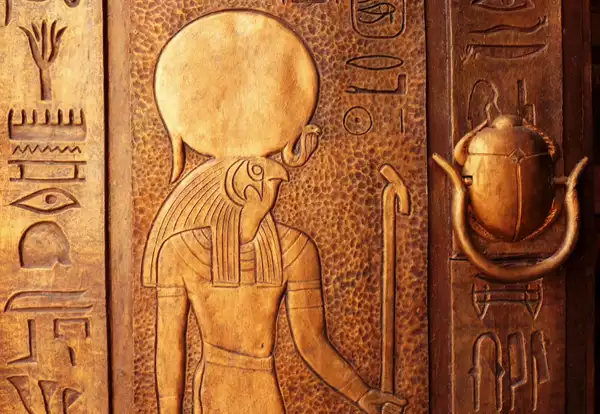
- The ancient Egyptians had over 2,000 gods and goddesses. These deities helped the people understand the world around them. The Egyptians passed on the stories of the deities through oral tradition. We know these stories as Egyptian mythology.
- Book Choices
- Egyptian Mythology by Erin Palmer (ISBN 9781683428947)
- Treasury of Egyptian Mythology by Donna Napoli (ISBN 9781426313806)
- Create an original god and match the Egyptian gods and goddesses with their names using these activities from History’s Histories.
- Use Wayground (reviewed here) to create a drag-and-drop activity for students to match the gods and goddesses with their names.
- Review this list of Egyptian Gods (reviewed here).
- Learn more about selected gods and goddesses and play an interactive game on the University of Manchester's website.
- Play Battle of the Gods with your students! This game incorporates research, oral language, and cooperative learning.
Hieroglyphics
- Hieroglyphics are the formal writing system of Ancient Egypt. This system is symbol-based.
- Book Choices
- Hieroglyphics from A to Z by Peter Manuelian (ISBN 9780590400084)
- The Shipwrecked Sailor: An Egyptian Tale with Hieroglyphs by Tamara Bower (ISBN 9780689830464)
- Create a papyrus scroll and have your students write their names in hieroglyphics. Students can also use Write Like an Egyptian (reviewed here) to see their names in hieroglyphics to add to their scrolls.
- History’s Histories has a hieroglyphics Scrabble game for older students.
- Learn more about hieroglyphics and drag and drop them to make words with the University of Manchester.
- The Egyptian system of mathematics is also written in hieroglyphics. Discover more hieroglyphics, then practice using hieroglyphic numbers here.
Videos
- Ancient Egypt 101 - National Geographic
- Top 10 Secrets of Ancient Egypt - History Channel
- Ancient Egypt and the Nile River Valley - Khan Academy
Extensions
Burial Chambers
- Learn more about the intricate structures underneath the pyramids. Learn about the different rooms and the twists and turns that were supposed to lead people away from the actual burial chamber.
- Create a diorama of an Egyptian burial chamber and ask students to record a short narrative about the project using Vocaroo (reviewed here). Use a QR code generator like QRCode Monkey (reviewed here) to generate a QR code for each student’s recording, then print it on a label affixed to an area of the diorama where it can be easily scanned.
Play Senet
- This historic race game involves moving sticks or coins across a gridded board to reach the end. Make a homemade board using a 3x10 grid on a piece of paper or cardboard. There is also an online version to try.
- Watch this video explaining the game.
Connect to Social Studies
- Students can create "clay pottery," "beads," or "scrolls," and take turns bartering and trading with each other using play coins or buttons.
Create a comprehensive resource to share with students
- Add your resources (including articles, worksheets, videos, and more) to a new notebook using Gemini Notebook (reviewed here). Create study materials, images, videos, slides, and more to help students explore and understand the life and times of Ancient Egypt.
Correlation to Standards
-
AASL National School Library Standards
- Inquire Shared Foundation, Think Domain - Learners display curiosity and initiative by:
- 1. Formulating questions about a personal interest or a curricular topic.
- 2. Recalling prior and background knowledge as context for new meaning.
- Inquire Shared Foundation, Share Domain - Learners adapt, communicate, and exchange learning products with others in a cycle that includes:
- 1. Interacting with content presented by others.
- 2. Providing constructive feedback.
- 3. Acting on feedback to improve.
- 4. Sharing products with an authentic audience.
- Include Shared Foundation, Share Domain - Learners exhibit empathy with and tolerance for diverse ideas by:
- 1. Engaging in informed conversation and active debate.
- 2. Contributing to discussions in which multiple viewpoints on a topic are expressed.
- Include Shared Foundation, Grow Domain - Learners demonstrate empathy and equity in knowledge building within the global learning community by:
- 1. Seeking interactions with a range of learners.
- Engage Shared Foundation, Think Domain: Learners follow ethical and legal guidelines for gathering and using information by:
- 1. Responsibly applying information, technology, and media to learning.
- 2. Understanding the ethical use of information, technology, and media.
- Engage Shared Foundation, Create Domain: Learners use valid information and reasoned conclusions to make ethical decisions in the creation of knowledge by:
- 1. Ethically using and reproducing others’ work.
- 2. Acknowledging authorship and demonstrating respect for the intellectual property of others.
- 3. Including elements in personal-knowledge products that allow others to credit content appropriately.
- Engage Shared Foundation, Grow Domain: Learners engage with information to extend personal learning by:
- 1. Personalizing their use of information and information technologies.
- 2. Reflecting on the process of ethical generation of knowledge.
- 3. Inspiring others to engage in safe, responsible, ethical, and legal information behaviors.
- Collaborate Shared Foundation, Think Domain - Learners identify collaborative opportunities by:
- 1. Demonstrating their desire to broaden and deepen understandings.
- 2. Developing new understandings through engagement in a learning group.
- 3. Deciding to solve problems informed by group interaction.
- Collaborate Shared Foundation, Create Domain - Learners participate in personal, social, and intellectual networks by:
- 1. Using a variety of communication tools and resources.
- 2. Establishing connections with other learners to build on their own prior knowledge and create new knowledge.
- Collaborate Shared Foundation, Grow Domain - Learners actively participate with others in learning situations by:
- 2. Recognizing learning as a social responsibility.
- Explore Shared Foundation, Think Domain - Learners develop and satisfy personal curiosity by:
- 1. Reading widely and deeply in multiple formats and writing and creating for a variety of purposes.
- Explore Shared Foundation, Create Domain - Learners construct new knowledge by:
- 1. Problem solving through cycles of design, implementation, and reflection.
- Explore Shared Foundation, Share Domain - Learners engage with the learning community by:
- 3. Collaboratively identifying innovative solutions to a challenge or problem.
- Explore Shared Foundation, Grow Domain - Learners develop through experience and reflection by:
- 1. Iteratively responding to challenges.
- 2. Recognizing capabilities and skills that can be developed, improved, and expanded.
- 3. Open-mindedly accepting feedback for positive and constructive growth.
-
ISTE Standards for Students
- Empowered Learner 1.1
- 1.1.b. Students build networks and customize their learning environments in ways that support the learning process.
- 1.1.c. Students use technology to seek feedback that informs and improves their practice and to demonstrate their learning in a variety of ways.
- Digital Citizen 1.2
- 1.2.c. Demonstrate an understanding of and respect for the rights and obligations of using and sharing intellectual property.
- Knowledge Constructor 1.3
- 1.3.d. Students build knowledge by actively exploring real-world issues and problems, developing ideas and theories, and pursuing answers and solutions.
- Innovative Designer 1.4
- 1.4.d. Students exhibit a tolerance for ambiguity, perseverance, and the capacity to work with open-ended problems.
- Global Collaborator 1.7
- 1.7.c. Students contribute constructively to project teams, assuming various roles and responsibilities to work effectively toward a common goal.