
It's All Greek to Me - Taking a closer look at Ancient Greece
Introduction | Background Knowledge | Activities | Extensions | Standards
Introduction
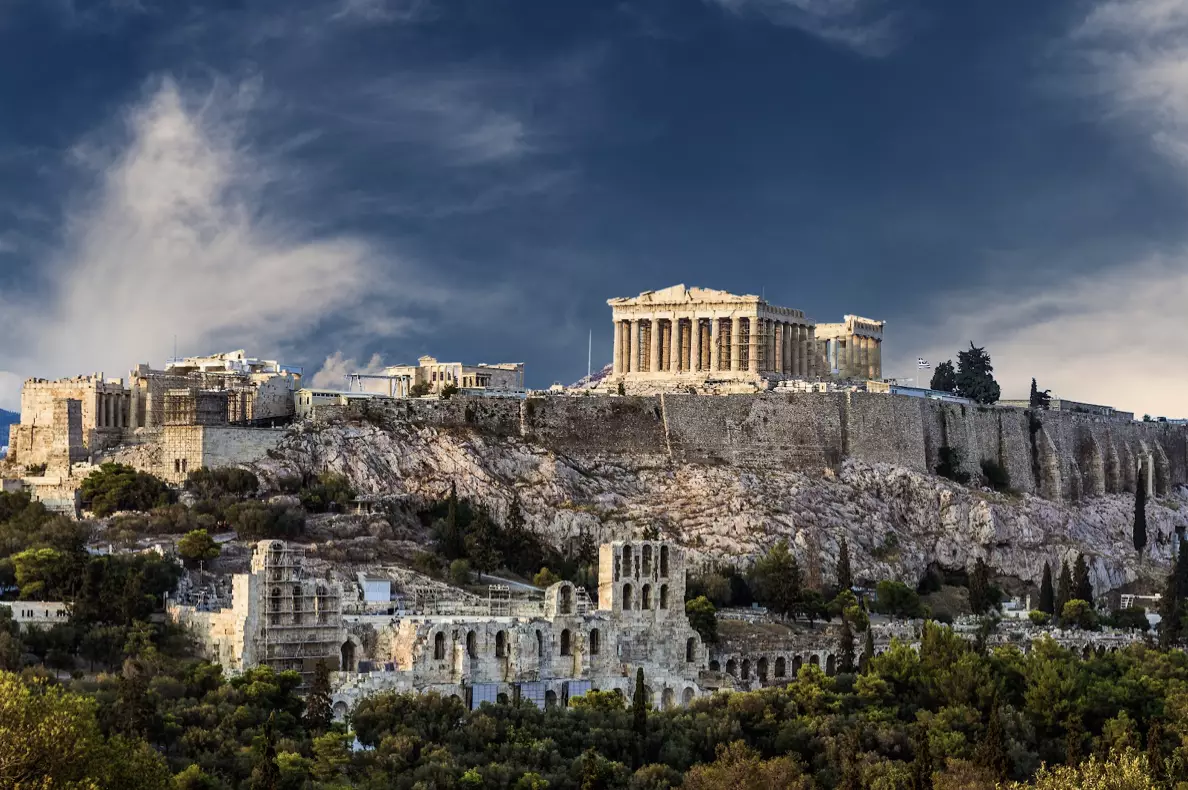
Ancient Greece was the seat of knowledge for thousands of years. It was the birthplace of the Olympic Games, and Greek Mythology was the basis for the stories of the constellations in every night sky. From the fierce warriors of Sparta and the face that launched a thousand ships, Ancient Greece was the basis for many of the ideals that we know today.
Click the image above to view a video that shows more about Ancient Greece.
Background Knowledge
Ancient Greek civilization began at the end of the Dark Ages when the Mycenaean civilization fell in the 8th century BCE. During these 200 years of settlement and organization, the Ancient Greeks laid the foundation for the powerful civilization that would follow. This period saw a series of wars and conflicts, but four city-states rose to dominance: Athens, Sparta, Corinth, and Thebes. Each of these city-states had its own rules and leaders. In 510 BCE, Athens and Sparta remained in conflict when Cleisthenes of Athens proposed a system in which all people could participate in governing, regardless of social class. They called this democracy, and its inception calmed tensions and ushered in the Golden Age in Athens.
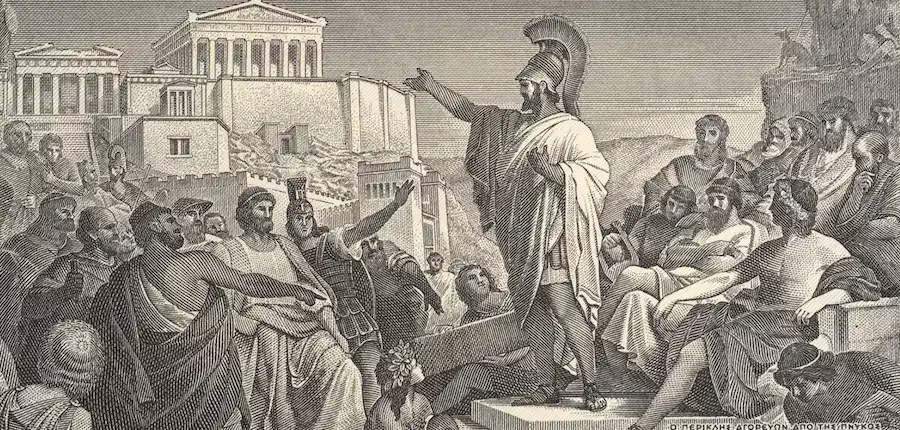
The Golden Era in Athens is also known as Fifth-century Athens. This era spanned from 480 to 404 BCE. This was a time of great cultural advancement. The legacy of Ancient Greece comes primarily from this era. Architecture was a major focus during this time. The Acropolis in Athens was reconstructed after a fire destroyed it, and it sat in ruins for 30 years. The Temple of Apollo at Delphi, later destroyed by an earthquake, was also reconstructed. Athens became the mecca for theater. Pericles, the ruler at the time, valued the theater and required the wealthiest citizens to support it by funding the Greek chorus and actors. The Golden Era was also the age of philosophy. The great philosophers of Ancient Greece - Socrates, Plato, and Aristotle - shared their wisdom. A focus on language and oration was also an important aspect of the era.
Classical Greece was an almost two-century-long period that ran from 499 BCE until the death of Alexander the Great in 323 BCE. The Greek city-states continued to feud, causing several conflicts. Some city-states would be peaceful, while others would be at war. In 431 BCE, Athens and Sparta began fighting the Peloponnesian War. Both sides agreed to a short-lived peace before conflict broke out again. Sparta emerged victorious and took control of Ancient Greece. Stretched too thin to maintain control, Sparta succumbed to a 395 BCE attack by Athens, Thebes, and Corinth, which began the Corinthian War. After eight years, the war ended in a stalemate, and Greece returned to Spartan rule. Power continued to shift until Philip of Macedonia led the allied forces of Thebes and Athens at the Battle of Chaeronea in 338 BCE. He united the city-states, which joined the Hellenic League. His son, Alexander, came to power in Ancient Greece upon Philip’s death. The individual city-states began to move away from independent rule and toward the Hellenistic model.
With the death of Alexander the Great in 323 BCE, the Hellenistic Period of Ancient Greece began. This period lasted until the Romans annexed Greece in 146 BCE, ending Greece’s independent rule. The city-states separated into two factions: the Achaean League (composed of Thebes, Corinth, and Argos) and the Aetolian League (composed of Sparta and Athens). These factions were often at war with each other and with the remnants of Alexander the Great’s empire. Greece was embattled in war with Rome beginning in the late 3rd century. These conflicts continued until the Aetolian League was conquered and absorbed by the Roman Empire in 146 BCE. This ended Greek independence and the Ancient Greek civilization.
The legacy of Ancient Greece is evident in its cultural developments. The Pythagorean theorem and Pi have emerged and remain relevant in modern mathematics. In sports, the Olympics began in Ancient Greece. Advances in architecture are evident in modern-day Washington, DC, in the columns of the US Supreme Court building and in the design of the US Capitol. The idea of democracy was born in Ancient Greece. The Greeks also created realistic, life-like sculptures that Renaissance artists copied. Finally, the religious structure of the Ancient Greeks was copied by the Romans and has permeated literature into modern times.
ACTIVITIES
Explore TeachersFirst’s Special Topics Page of Ancient Greece resources (found here).
Greek Mythology
- Echo, Echo: Reverso Poems about Greek Mythology by Marilyn Singer (ISBN 9781338188271)
- Learn about the Olympians by reading the same poem from the top to the bottom and the bottom to the top.
- The Lightning Thief by Rick Riordan (ISBN 9780786838653)
- This is the first book in a five-book series about Percy Jackson, son of Poseidon. Zeus accuses Percy of stealing his lightning bolt and gives him two weeks to return it before starting a war with Poseidon. Percy and his friends have to find the entrance to the Underworld and stop the war.
- Rick Riordan has created a teacher’s guide for The Lightning Thief and the other books in the series.
- Write myths about your school. Learn more from this website. Share the myths on a virtual board, like Padlet (reviewed here).
- Check out these ideas from Storyboard That! You can also create a free storyboard using Canva’s Comic Strip Templates (reviewed here).
- Create a Family Tree Project. Draw or map out a Greek mythology family tree, illustrating the major gods, goddesses, and their symbols (like Poseidon's trident or Athena's owl). Students can also use Canva for Education (reviewed here) for a technology option.
- Create a timeline or infographic using MyLens (reviewed here) to illustrate key events in Greek mythology.
- Use Project Zero Thinking Routines (reviewed here) throughout your class’s reading of The Lightning Thief to extend students’ understanding of the concept of a hero’s journey. For example, use the Step Inside routine to have students look from the perspective of one of the gods, or the Circle of Viewpoints to explore the conflict at the end of the book and unpack how perspective shapes "who's right."
The Olympics
- Hour of the Olympics by Mary Pope Osborne (ISBN 9780679890621) and its companion guide, Ancient Greece and the Olympics by Mary Pope Osborne (ISBN 9780375823787)
- Learn more about the Ancient Olympics from the International Olympic Committee. Compare the original games to the modern Olympics using Canva’s Venn Diagram Creator (reviewed here).
- Examine artifacts from the Met focusing on the Olympics. Use this resource from the British Museum to provide information to support the artifacts.
- Visit the TeachersFirst Summer Olympics (reviewed here) and Winter Olympics (reviewed here) Special Topics Pages to find additional options for teaching about the Olympics.
- Mr. Donn’s Social Studies (reviewed here) provides historical information about the Olympics on a page related to the Ancient Greek Olympics.
- Partner with your school’s Physical Education teacher to pair math and physical education to see How Students Measure Up in Olympic events.
- Host a class, grade-level, or whole-school Olympic games with fun, silly, or serious activities. 10 Fun Olympic Game Ideas for Kids has some wonderful ideas that can be further used as STEAM activities as students assess their successes and seek additional designs for greater success. Students could also create games focusing on teamwork in small groups.
Daily Life and Culture
- Read Ancient Greece Inside Out by John Malam (ISBN 9780778728764)
- Mr. Donn’s Social Studies class offers excellent, engaging activities that get students excited about Ancient Greece.
- Ducksters (reviewed here) is always a great resource. It provides great information, has a recorded option, and provides a 10-question quiz to check for understanding.
- A meander (or meandros) is an artistic border that is created from a continuous line. This decoration was an important symbol of Ancient Greece, its continuous line possibly representing unity. The meander began to appear on vases and in architecture starting in 900 - 700 BCE. Students can create their own meander as a math/art activity. This style guide explains how to create colorful meanders. Explore digitally created meanders here and vary the size, design, and style. Consider using GooseChase (reviewed here) for an online meander scavenger hunt to locate as many different types of items as possible within a given time frame.
- Set up a classroom marketplace where students act as merchants and citizens in an Athenian agora. Using tokens or a hypothetical budget, students buy and sell traded goods of the era (olive oil, pottery, grain, wine/grapes). Have students use Book Creator (reviewed here) to create an illustrated catalog of goods for sale in their market, complete with digital drawings, historical descriptions of the goods, and currency exchange rates.
Videos
- Learn Bright’s Ancient Greece for Kids
- 5 Things You Should Know About Ancient Greece by Smile and Learn
- Ancient Greece by Happy Learning English
- Ancient Greece in 18 Minutes by Arzamas
EXTENSIONS
Nectar of the Gods
- Ancient Greek religion was based on polytheism, a belief in multiple gods and goddesses. Mount Olympus was the home of the gods, whom the powerful Zeus led. There are 12 major gods, collectively known as the 12 Olympians. When Ancient Greece fell to Rome, Roman culture adopted the Greek model of polytheism and inherited many of the same elements.
- Visit the J. Paul Getty Museum and use the Getty Education - Curricula and Teaching Guides (reviewed here) to explore Greek and Roman Mythology in Art. To visit virtually, search the collection to find the pieces mentioned in the resources.
- Students can research the Greek and Roman gods and write a story about what would happen if they met today.
- Technology Approach: Use Adobe Podcast (reviewed here) to create a short podcast to tell the story of meeting a Greek or Roman god in an unexpected situation. Students can collaborate in groups to create podcasts together.
- Non-technology Approach: Print Canva Comic Strip Templates (reviewed here) for students to use when drawing comics.
Greek Architecture
- The Paper Cup Parthenon
- Introduce kids to the "post and lintel" weight distribution system used by Greek architects.
- Take a virtual tour of the Parthenon through Google Arts and Culture (reviewed here).
- Technology Approach: Build a temple using Tinkercad (reviewed here) or use the search option to find a template at Sketchfab Greek Temple Model Library (reviewed here). Students can also learn about Greek architecture by playing this game from the Acropolis Museum, in which they become the architect of a new temple. The game is available in English by selecting “EN” on the page.
- Non-technology Approach: Have your students try to balance a heavy book on a single paper cup; it will crumple instantly. Next, have them arrange 12 to 16 paper cups in a rectangular grid, place a piece of cardboard or a cookie sheet over them, and stack several heavy books on top. The distributed weight highlights how columns support massive stone roofs.
CORRELATION TO STANDARDS
-
AASL National School Library Standards
- Inquire Shared Foundation, Think Domain - Learners display curiosity and initiative by:
- 1. Formulating questions about a personal interest or a curricular topic.
- 2. Recalling prior and background knowledge as context for new meaning.
- Inquire Shared Foundation, Share Domain - Learners adapt, communicate, and exchange learning products with others in a cycle that includes:
- 1. Interacting with content presented by others.
- 2. Providing constructive feedback.
- 3. Acting on feedback to improve.
- 4. Sharing products with an authentic audience.
- Include Shared Foundation, Share Domain - Learners exhibit empathy with and tolerance for diverse ideas by:
- 1. Engaging in informed conversation and active debate.
- 2. Contributing to discussions in which multiple viewpoints on a topic are expressed.
- Include Shared Foundation, Grow Domain - Learners demonstrate empathy and equity in knowledge building within the global learning community by:
- 1. Seeking interactions with a range of learners.
- Engage Shared Foundation, Think Domain: Learners follow ethical and legal guidelines for gathering and using information by:
- 1. Responsibly applying information, technology, and media to learning.
- 2. Understanding the ethical use of information, technology, and media.
- Engage Shared Foundation, Create Domain: Learners use valid information and reasoned conclusions to make ethical decisions in the creation of knowledge by:
- 1. Ethically using and reproducing others’ work.
- 2. Acknowledging authorship and demonstrating respect for the intellectual property of others.
- 3. Including elements in personal-knowledge products that allow others to credit content appropriately.
- Engage Shared Foundation, Grow Domain: Learners engage with information to extend personal learning by:
- 1. Personalizing their use of information and information technologies.
- 2. Reflecting on the process of ethical generation of knowledge.
- 3. Inspiring others to engage in safe, responsible, ethical, and legal information behaviors.
- Collaborate Shared Foundation, Think Domain - Learners identify collaborative opportunities by:
- 1. Demonstrating their desire to broaden and deepen understandings.
- 2. Developing new understandings through engagement in a learning group.
- 3. Deciding to solve problems informed by group interaction.
- Collaborate Shared Foundation, Create Domain - Learners participate in personal, social, and intellectual networks by:
- 1. Using a variety of communication tools and resources.
- 2. Establishing connections with other learners to build on their own prior knowledge and create new knowledge.
- Collaborate Shared Foundation, Grow Domain - Learners actively participate with others in learning situations by:
- 2. Recognizing learning as a social responsibility.
- Explore Shared Foundation, Think Domain - Learners develop and satisfy personal curiosity by:
- 1. Reading widely and deeply in multiple formats and writing and creating for a variety of purposes.
- Explore Shared Foundation, Create Domain - Learners construct new knowledge by:
- 1. Problem solving through cycles of design, implementation, and reflection.
- Explore Shared Foundation, Share Domain - Learners engage with the learning community by:
- 3. Collaboratively identifying innovative solutions to a challenge or problem.
- Explore Shared Foundation, Grow Domain - Learners develop through experience and reflection by:
- 1. Iteratively responding to challenges.
- 2. Recognizing capabilities and skills that can be developed, improved, and expanded.
- 3. Open-mindedly accepting feedback for positive and constructive growth.
- ISTE Standards for Students
- Empowered Learner 1.1
- 1.1.b. Students build networks and customize their learning environments in ways that support the learning process.
- 1.1.c. Students use technology to seek feedback that informs and improves their practice and to demonstrate their learning in a variety of ways.
- Digital Citizen 1.2
- 1.2.c. Demonstrate an understanding of and respect for the rights and obligations of using and sharing intellectual property.
- Knowledge Constructor 1.3
- 1.3.d. Students build knowledge by actively exploring real-world issues and problems, developing ideas and theories, and pursuing answers and solutions.
- Innovative Designer 1.4
- 1.4.d. Students exhibit a tolerance for ambiguity, perseverance, and the capacity to work with open-ended problems.
- Global Collaborator 1.7
- 1.7.c. Students contribute constructively to project teams, assuming various roles and responsibilities to work effectively toward a common goal.